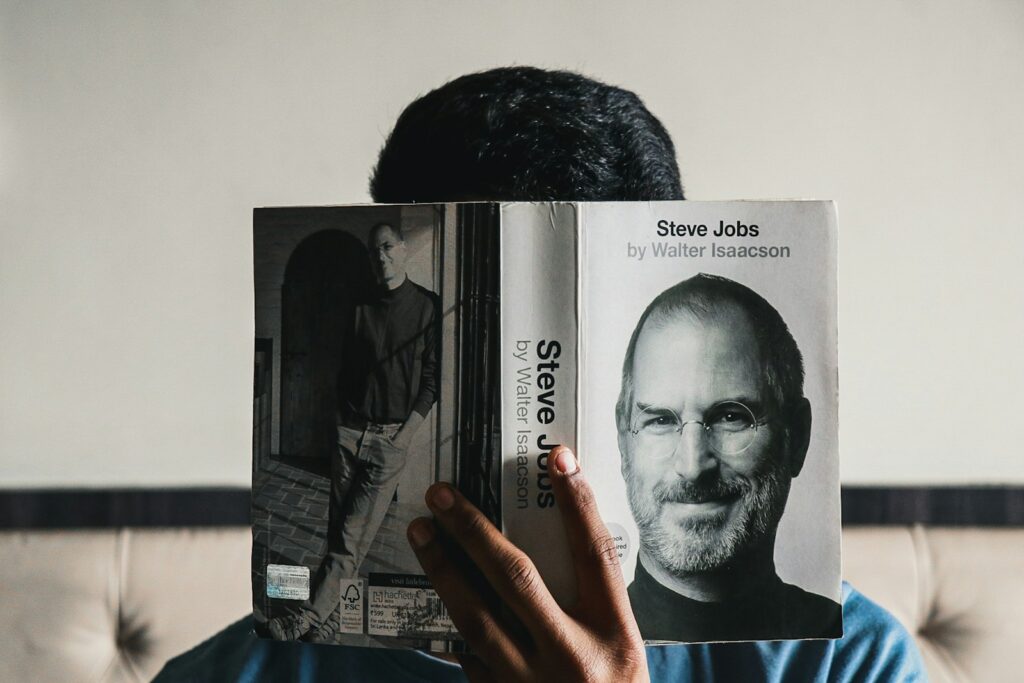
“Nothing great in the world has ever been accomplished without passion.” — G.W.F. Hegel
Steve Jobs leadership lessons: Vision & Idealism
One of the most enduring Steve Jobs leadership lessons was his ability to view technology through a liberal arts lens—a human-centered perspective.
In Make Something Wonderful, Jobs used the Macintosh as an example. Its desktop publishing inspiration came from books—typography, design, richness. Few in the industry grasped this.
Jobs had many strengths, but he admitted one weakness: being too idealistic.
He reminded himself: “best is the enemy of better.” Too often, he chased perfection when better would have sufficed—and it sometimes set him back.
Jobs also admitted he wasn’t always wise. At times, he was blinded by what could be—instead of what was incrementally possible.
He struggled to balance the ideal with the practical—and knew it required constant attention.
Like Jobs, Apple had strengths and weaknesses. Its greatest strength was holding onto a core value: people with passion could change the world.
The company worked with people—developers and customers—who wanted to change the world, in both big and small ways.
This belief set Apple apart from other brands: the conviction that passionate people can change the world.
Jobs put it simply: “People crazy enough to think they can change the world are the ones who do.” Apple aimed to embody that spirit.
To communicate those values, Apple hired a new agency and launched a campaign.
Much had changed in the prior decade—Apple’s market, products, marketing, and distribution. The company knew it needed to communicate its essence again.
Yet while everything else evolved, Apple’s core values remained unchanged.
So Apple launched a campaign honoring people who changed the world.
Some honorees were living; others were long gone.
The campaign’s theme was “Think Different.” It celebrated those who thought differently and moved the world forward—exactly what Apple aspired to.
For Jobs, thinking differently meant looking forward, not backward. Dwelling on the past, he believed, was wasted energy.
His mantra: “Invent tomorrow. Don’t worry about yesterday.”
Resilience & Reinvention
Among the most powerful Steve Jobs leadership lessons is his story of resilience and reinvention.
He was forced out of Apple—fired from the company he built. Jobs admitted it was brutal, as it would be for anyone. Yet he learned a great deal from the experience.
Jobs later reflected that without being fired, there would have been no Pixar.
Your greatest strengths can also become your greatest weaknesses. And adversity, Jobs said, is often where you learn the most. In hindsight, getting fired became an opportunity for growth.
Jobs compared it to “awful-tasting medicine,” but medicine he needed.
“Sometimes life hits you in the head with a brick,” Jobs said. “Don’t lose faith.”
What kept him going was simple: he loved what he did.
“You’ve got to find what you love,” he said. “That’s as true for work as for relationships.”
“Your work will fill a large part of your life. The only way to be satisfied is to believe you’re doing great work. And the only way to do great work is to love what you do.”
“If you haven’t found what you love to do yet, keep looking—don’t settle,” Jobs urged. “As with all matters of the heart, you’ll know when you find it. And like a great relationship, it only gets better over time.”
So keep looking. Don’t settle.
Running Apple was something Jobs loved. Being fired didn’t feel like it then, but in hindsight, it was the best thing that happened to him. The lightness of starting over replaced the heaviness of success.
That freedom sparked one of the most creative periods of his life.
Over the next five years, he started NeXT, launched Pixar, and met the woman he would marry.
Pixar created the first computer-animated feature, Toy Story, a success that cemented it as the world’s leading animation studio.
Apple eventually bought NeXT, bringing Steve back. The technology he developed there became the heart of Apple’s renaissance.
Mortality & Urgency
Another of the timely Steve Jobs leadership lessons in Make Something Wonderful is his reminder: life is short. Don’t waste it living someone else’s life. Don’t be trapped by dogma—living with the results of other people’s thinking.
“Don’t let others’ opinions drown out your inner voice.”
“Have the courage to follow your heart and intuition.”
Mortality runs throughout the book. Jobs often reminded himself: we’re all going to die. For him, it was the best way to avoid the illusion of having something to lose.
Jobs tells the story of his cancer diagnosis: an early-morning scan revealed a clear tumor on his pancreas.
Doctors told him it was almost certainly incurable—six months to live.
His doctor advised him “to get his affairs in order”—code for prepare to die. That meant compressing the next decade of fatherhood into six months.
It meant buttoning up life for his family—and saying goodbyes.
He lived with that diagnosis all day—until a biopsy revealed, to the doctor’s relief, it was a rare but curable form.
He survived then, though we know how the story ends. At the time, it was his closest brush with death—once abstract, now suddenly frighteningly real.
“No one wants to die. Even people who want to go to heaven don’t want to die to get there,” he said. Yet death is universal. No one escapes it.
Jobs called death “life’s best invention”—its change agent. It clears out the old to make way for the new.
As a young man, Jobs devoured The Whole Earth Catalog—a bible of his generation—like Google in paperback 35 years before Google.
Stewart Brand published several editions. When it ended in the mid-1970s, the final issue carried a farewell.
On its back cover: an early-morning country road, the kind you might hitchhike on.
Beneath it: “Stay hungry. Stay foolish.”
It was their sign-off: “Stay hungry. Stay foolish.”
Jobs said he always wished that for himself.
Legacy & Long-Term Thinking
On the eve of the iPhone launch in 2007, Jobs addressed Apple employees.
In his invite, he wrote they were about to launch “the most revolutionary product in Apple’s history”—no small claim given Apple’s legacy.
They had mastered iPods and saw the chance to create the next great product.
The spark? Everyone hated their phones. Features like conference calls technically existed—but were buried in manuals and unusable for most.
Apple excelled at making complex technology simple and self-discoverable.
The iPhone was Apple’s contribution: a product they loved—designed to be truly great. It became one of the defining Steve Jobs leadership lessons on building products that outlive trends.
At the same time, Jobs was also designing Pixar’s new headquarters.
Finding land was easy; deciding what kind of building to create was hard.
“As a renter, buildings reflect the owner,” Jobs said. “As an owner, you decide who you are.”
He compared it to making a Pixar movie: design, discard, redesign, iterate. It drove the architects nuts.
They wanted the building to capture Pixar’s soul—no easy task.
Every process was done the hard way: steel hand-jointed and bolted, bricks hand-made and hand-laid.
Workers said no owner had ever let them build this way. They even brought their families on weekends to admire their work, like Pixar families watching a Pixar film together.
Jobs saw the building as an investment in Pixar’s future: a tool to recruit top talent and create the best animated films in the world.
The purpose wasn’t appearances. It was to house the most talented filmmakers—and enable the best animated art ever made.
He wanted Pixar to be laser-focused on that mission: to build the best animation studio.
He worked to understand the pieces of a great studio and how to attract top talent—only then could the strategy come together.
One of his joys was finding people better than him at something—it freed him to focus elsewhere.
All of that talent aligned around one goal: storytelling. No technology could redeem a bad story. Pixar worked relentlessly on good ones.
Jobs believed storytelling hasn’t changed in centuries—and might never.
Disney proved it with Snow White. Sixty years later, its re-release earned over $250 million in profit.
His young son watched Snow White 30–40 times, Jobs said. The story renewed itself with a new generation.
Jobs compared Snow White to Toy Story. People wouldn’t rewatch for the graphics—they’d return for the story of friendship.
Pixar, Jobs said, had the chance to place films like Toy Story into culture. If they worked hard—and had luck—maybe, just maybe, it would still matter in 60 years.